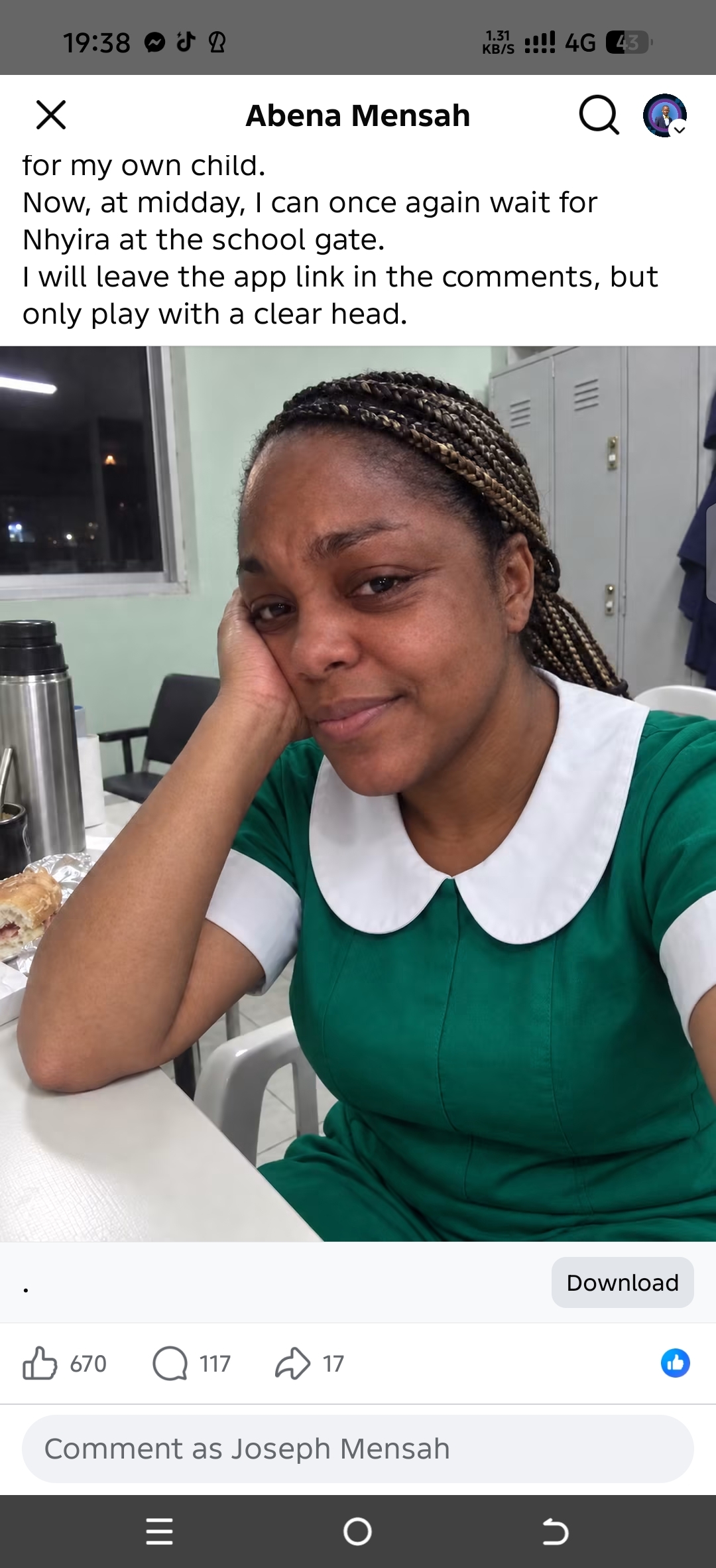
“My name is Abena Mensah. I am 34 years old, and I have worked as a nurse at Korle Bu Teaching Hospital in Accra for eight years. I am raising my eight-year-old daughter, Nhyira, on my own.
My night shifts start at 6 p.m. and end at 6 a.m. I take a trotro home, still wearing my nursing uniform. I sleep for about four hours, do the housework, then go to collect Nhyira from school.
At weekends, I also work at a small private clinic in East Legon. After all the deductions and my loan repayment, I am left with about GH¢3,100 from my main salary. In a good month, together with the extra job, I make a maximum of GH¢3,800. But the money is still barely enough.
My ex-husband left two years ago. He sends money for Nhyira once every two or three months, so I cannot depend on it. We rent a small self-contained room in Mamprobi for GH¢1,300 a month.
My financial problems started about ten months ago when our former landlord sold the place, gave us two weeks to move out and refused to return my deposit. After closing from a night shift, I found empty boxes outside the door and a message on my phone giving me the final date to leave.
Nhyira looked at the boxes and asked:
“Mummy, will I be able to stay at the same school?”
“Yes, my girl. You will. I promise.”
I said it confidently, even though I still had no idea where I would find the money.
The new landlord demanded one year’s rent advance. To keep my daughter at the same school and avoid being left without a place to stay, I took a salary loan and borrowed money from my mother and my colleague Mabel. The move, school expenses and the interest that followed gradually increased my debt to GH¢24,000. No matter how much I worked, it hardly went down.
At some point, I started feeling as if I no longer existed. I had not bought anything for myself in over a year. I had three nursing uniforms, and two of them were already worn through at the knees. I bought my work shoes on credit because I could not afford the Crocs I had wanted for so long.
One night in July, a man in critical condition was brought to us. At around three in the morning, the doctor went outside to speak to his family while I remained in the ward, trying to put everything in order. Because of the difficult case and the handover to the next shift, my duty went on longer than expected.
Afterwards, I sat on the edge of an empty bed for about ten minutes. I did not cry. At work, I had learned long ago how to control myself.
As I travelled home in a trotro, the sun was already rising over Accra. That was when I realised I had been on my feet for about sixteen hours and had not eaten anything since the previous evening.
I still had to get home, sleep for three hours and collect Nhyira from school at midday.
I remember thinking:
“Is this what my whole life is going to be like?”
Things were also becoming worse at the private clinic. Mrs Boadu watched every minute, demanded an explanation for every delay, gave me warnings and sometimes deducted part of my pay.
Once, she made me stay for an extra hour without pay because I had to “finish the shift properly”. I did not argue because I needed the job. By Sunday evening, I was already dreading the following weekend.
One day, Nhyira asked me:
“Mummy, why are you always so serious?”
“I’m just tired.”
She looked at me for a few seconds and then asked:
“Are you tired of me?”
She was only eight years old.
I held her tightly.
“No, my girl. Never. Not for anything in this world.”
I held her for a long time, and that question stayed in my mind for several days.
At a parents’ meeting at Nhyira’s school, I met Adwoa, the mother of one of her classmates. A few months earlier, she had looked completely exhausted: dark circles under her eyes, creased clothes and the same tired expression I saw in the mirror every day.
But that day she looked calm. Something had clearly changed.
I asked her what had happened. Adwoa looked at me and said:
“Things are bad for you right now, aren’t they? A few months ago, I looked exactly the same.”
When the children went back to class, we stayed outside the school and talked for a while. That was when she told me about the app.
Adwoa opened MTN MoMo and showed me three payments she had received over the past few months. Then she opened the transaction history inside the app: the balance, withdrawal requests, “processing” and “completed” statuses, as well as the payment notifications. The dates and amounts matched.
She said:
“Start with only 10 cedis. Do not use more than that. If you win, withdraw the money immediately. After that, continue only with the part of the winnings you can afford to lose completely.”
That evening, after Nhyira fell asleep, I registered and deposited the last spare 10 cedis from my MTN MoMo wallet. It was not money for rent, food, school, medication or electricity. I told myself that if nothing came from it, I would delete the app immediately.
The first spin gave me nothing. A few coins appeared on the second. The third gave me nothing again.
I was already about to close the app when I won GH¢400.
I immediately requested to withdraw the full amount. When the money reflected in my account, I put GH¢160 aside for food, kept GH¢80 for trotro fares and deposited GH¢160 from the winnings back into the app.
Now I knew the withdrawals worked, and I was no longer using my own money, only part of what I had won.
This continued for about a week. I always used only a small part of what I had already won, and I never topped up more than GH¢400 at a time. By the end of the week, I had managed to build it up to about GH¢1,200 without adding anything from my salary or the family budget.
I probably would have continued like that if it had not been for a message from Mrs Boadu.
She wrote that I was no longer needed at the private clinic.
Just like that. No explanation and not even one kind word.
I realised that I had lost my only extra income. The loan repayment was still being deducted from my salary, and the debt had hardly reduced. Without the extra job, it would start growing again.
I stared at the GH¢1,200 I had built up. I could withdraw it and use it for a few days of food and trotro fares, but it would still not be enough for either the rent or the debt repayments.
That money had come from my previous winnings, not from my salary. I kept GH¢160 for food and transport so that Nhyira and I would not be left with nothing, and I decided to use the remaining GH¢1,040.
I was afraid of losing it. But I also knew that without the extra job, I would soon start borrowing again before the next payday.
With the bonus included, the balance came to GH¢1,500. I used it to buy a bonus round.
Nhyira was already asleep. I sat in the dark kitchen so that I would not wake her. My hands were shaking, and I was holding my breath.
The first three free spins gave me nothing. I could feel my last hope disappearing.
Then suddenly the screen lit up.
The multipliers started:
×50… ×100… ×200… ×500…
My hands stopped obeying me.
When everything stopped, the screen showed:
GH¢55,000.
I did not move. I thought I had read the amount wrongly.
I closed the app and opened it again.
The money was still there in the balance:
GH¢55,000.
I pressed “Withdraw” and waited.
Every minute felt endless. About forty minutes later, I received a bank notification. Then a second one appeared.
I opened my banking app and checked the account.
The money had really come through.
I remained seated in the dark kitchen. I did not cry. I just took deep breaths and, for the first time in a very long time, I was not afraid.
I cleared the full GH¢24,000 debt and paid my mother back. I sent Mabel GH¢6,000, twice the GH¢3,000 she had lent me. I also paid GH¢6,500 for five months’ rent in advance.
I bought Nhyira new shoes, clothes, a light raincoat and the schoolbag she had wanted since March. I bought myself Crocs for work and finally booked the dental appointment I had been postponing. I put most of the remaining money into a separate savings account and kept a small part for occasional play, using only money I had already won.
On an ordinary Tuesday, we went to a small pizza place on Oxford Street in Osu. This time, we did not order takeaway. We sat down calmly at a table.
Nhyira ordered two slices of pizza and a Coca-Cola. I simply sat opposite her and watched her eat and smile.
The first time I went to collect Nhyira from school myself, she looked at me in surprise.
“Mummy? What are you doing here?”
“From now on, I will always come and collect you.”
She took my hand and did not let go until we reached home.
I sleep better now and finally have time to take care of myself. I still work as a nurse at Korle Bu Teaching Hospital, and I have no plans to leave the profession. Nursing is what I know and what I once chose for myself. But now I do it because I want to, not because I have no other option at all.
I am not saying that everyone will win. I am also not saying that gambling is a way to solve financial problems.
Never use money meant for rent, food, school, electricity, transport or medication. Do not risk an amount you cannot afford to lose.
I still follow Adwoa’s rule: if you win, withdraw the money first and put aside what you need. Continue only with a small part of the money you have already won and are prepared to lose completely.
For eight years, I cared for people who were not my family. On many days, I came home so exhausted that I had almost no strength left for my own child.
Now, at midday, I can once again wait for Nhyira at the school gate.”
Life is a great teacher and can be hard on you. Have courage and face it, how hard it may be on you.