
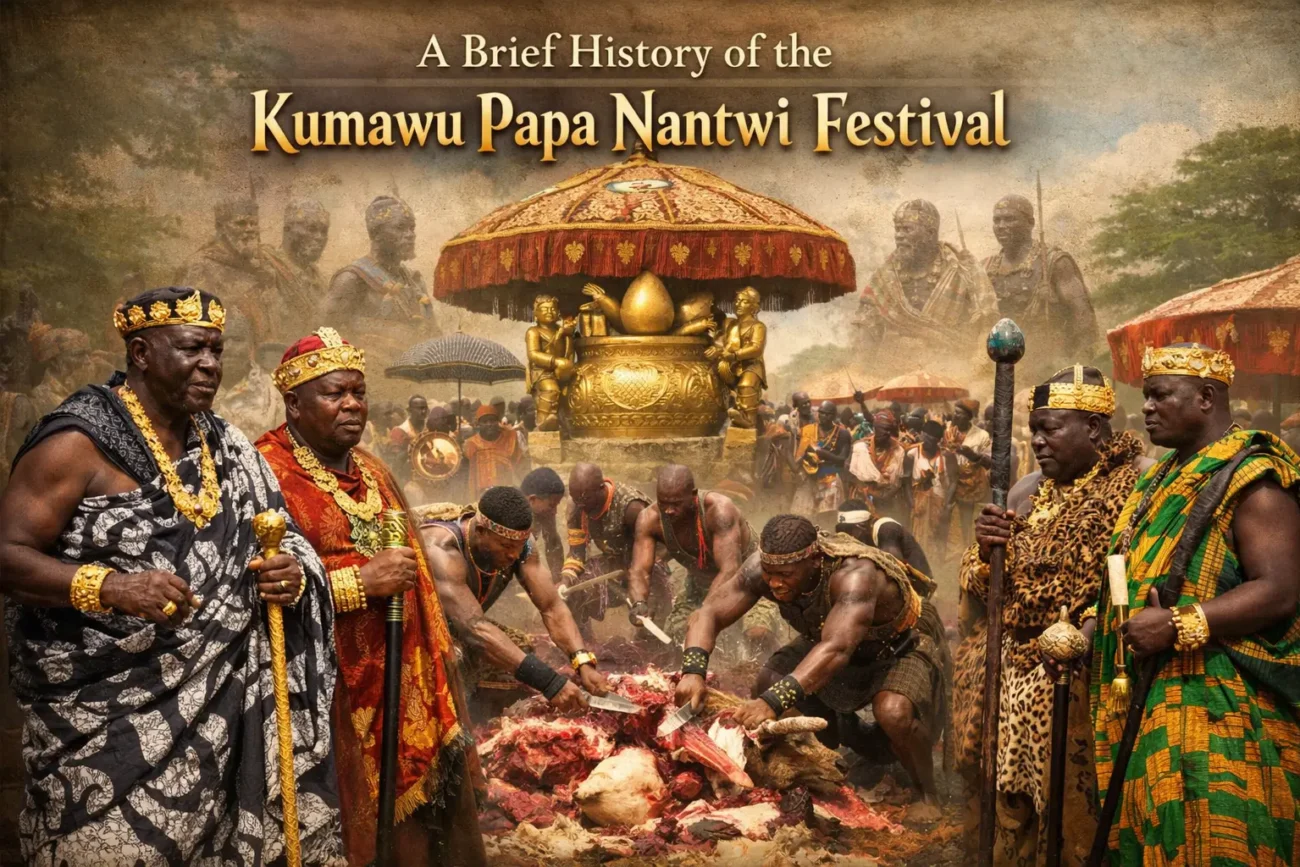
The most courageous warriors who proved themselves in the ritual were selected to join the military campaign against the powerful warrior Ataala Firam, a war that lasted from 1691 to 1698.
It was believed that the Papa Nantwi Festival of Kumawu (Apemso) traces its origin to the time of Nana Kofi Fekan, the sixth Paramount Chief of Apemso and a great-uncle of Barima Tweneboa Kodua I. Nana Kofi Fekan decided to wage war against the powerful warrior Ataala Firam, who ruled the Afram Plains.
Before going to war, Nana Kofi Fekan sought spiritual guidance on how to secure victory. The spiritual advisers instructed him to perform a special ritual. A sacrificial cow was tied at Papaase, and the chief himself had to slaughter it while receiving symbolic lashes from the chief of Papaase. This act was meant to test his bravery and endurance.
After the cow was slaughtered, its meat was placed in an open space. Warriors then rushed in with cutlasses, sticks, and other tools to cut and grab pieces of the meat. The fierce struggle tested their strength, courage, and determination. Those who succeeded in taking meat without serious injury were praised as brave warriors, while those who failed were mocked as cowards. Many participants also relied on traditional medicines and charms for protection during the contest.
The warriors who proved their bravery in this ritual were chosen to join the war against Ataala Firam, which lasted from 1691 to 1698.
Unfortunately, Nana Kofi Fekan was later killed in battle at Asabuso, forcing the Apemso forces to retreat for a while. Leadership then passed to his grand-nephew Barima Tweneboa Kodua I, who gathered a strong alliance of chiefs, including:
- Nana Ofori Krobon, Agogomanhene
- Nana Ntori Nimpa, Kwamangmanhene
- Nana Boamah, Beposohene
- Nana Oduro Panin, Nsutahene
- Yeboa Asiamah, Atebubuhene
Under his leadership, the allied chiefs launched a determined campaign to capture the fertile lands located between the Afram, Volta, and Pru rivers.
During their victory, the warriors captured the sacred Abammo, a beautifully decorated gold pot that symbolizes fertility and the origin of life. The pot had detailed designs, including a mother with twins, another child called Tawiah following behind, and an egg. These symbols were covered with a special umbrella-like cloth known as Abammokyeniɛ.
The Abammo was later kept in the care of Nana Taa Akyeampon, the Queen Mother of Kumawu at the time. As part of the festival celebrations, on the Saturday (Dapaa) before Akwasidae Festival, the Abammo pot and the sacred Black Stools are taken from the Stool House. They are then escorted by the Paramount Chief, the Queen Mother, and other elders to the Annorkosu stream for ritual purification. After the ritual, the Black Stools are returned for the early morning Akwasidae ceremonies.
In addition, the sacred crown of Ataala Firam was taken as a trophy and given to Nana Ofori Krobon, the Agogomanhene. The crown later became known as Krobon Kyɛ in his honour. Ivory trumpets known as Ntahra, which were also captured during the war, were given to Nana Oduro Panin, the Nsutamanhene. The conquered lands were then shared among the allied chiefs.
Today, the Papa Nantwi Festival celebrates the bravery, sacrifice, and heroism of the warriors who fought in those historic battles. The festival especially honours Barima Tweneboa Kodua I and the courageous warriors who fought to protect their land and uphold the rich heritage of Asanteman.
Follow SIRJOE ONLINE for more
Comments and share with others
